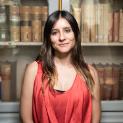
Sara Quintela Realista completed her PhD in Chemistry (2018) at Universidade de Lisboa Instituto Superior Técnico. After she
was a post-doctoral researcher of the FCT-financed project “Chemical Synthesis Using Earth-Abundant Metal Catalysts” at Instituto
de Tecnologia Química e Biológica (Universidade Nova de Lisboa).
She is currently a Junior Researcher CEEC-FCT at FCUL working in inorganic chemistry and electrochemistry. She published
23 articles in international peer-reviewed scientific journals, 2 article in a national scientific journal and 1 book chapter
(h-index = 12). She has been appointed a member of the editorial and revisors board of the journals Sustainability and Frontiers
in Chemistry and has been reviewing scientific articles for the MDPI journals. She was a member of the organising committee
of 1 international and 1 national event and a member of the scientific and organising committee of 2 international events.
She has received 3 awards one from the Fundação Calouste Gulbenkian and two from the Portuguese Chemical Society. In 2022,
she was awarded a fellowship as a visiting researcher at the Holland Research School of Molecular Chemistry (a collaboration
between Amsterdam and Leiden Universities). She (co-)supervised 5 MSc dissertations and 5 works of course completion of
LSc/BSc. Currently, she supervises a PhD student working on CO2 photoreduction and 2 BSc students working on preparing metal-organic
framework films using electrophoretic deposition and their application as memristors.
She participates/participated as a Principal investigator in 3 project, Research Fellow in 5 projects and Researcher in 6
projects. From 2020-2022 she lectured in the MSc course (Chemical Systems and reactivity) and in 2023 she lectured in another
MSc course (Supramolecular chemistry and Nanochemistry). In addition, during her visit to The Netherlands, she gave two lectures,
one to the BSc and another to the MSc courses in Chemistry, about metal-organic frameworks (basic principles and applications).
She works in the area of Exact Chemical Sciences with an emphasis on Inorganic Chemistry and Electrochemistry. She is skilled
in inorganic synthesis, electrochemistry, and catalysis fields. Her current scientific interests are focused on the preparation
of new electrode materials based on metal-organic frameworks using her inorganic/organic synthetic and electrochemical skills
to fulfil society's needs (clean energy and data storage).